4–20mA signal reliability is often assumed — but real-world behaviour can be very different.
We’ve shipped thousands of devices into the field.
In around 1 in 1000 cases — often at the same customer — we see something unexpected on a “safe” 4–20mA input.
So we tested it.
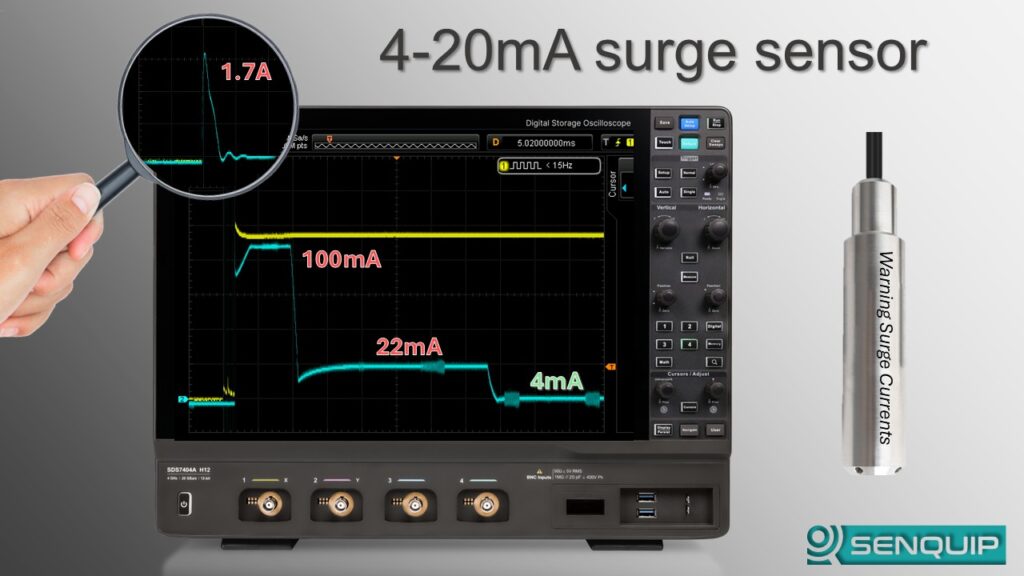
Using a well-known, high-quality sensor, we measured:
• ~1.7A current spike at power-up
• ~100mA sustained for a short period
This isn’t a fault.
It’s normal behaviour — at least for that device.
Our overcurrent protection trips in these cases, exactly as designed.
However, repeated events can occasionally stress current sense resistors over time.
Nothing dramatic — just gradual degradation.
This highlights an important point:
4–20mA signals are not always 4–20mA.
Startup conditions, internal capacitance, and sensor design can create current transients far beyond steady-state values.
For remote monitoring systems used on pumps, generators, and industrial equipment, this has real implications for long-term reliability.
That’s why we design for it.
Our latest 4–20mA inputs are built to tolerate surge currents up to ~4A — not because it’s expected, but because it happens.
Because real-world reliability isn’t about nominal values.
It’s about everything that happens outside them.