
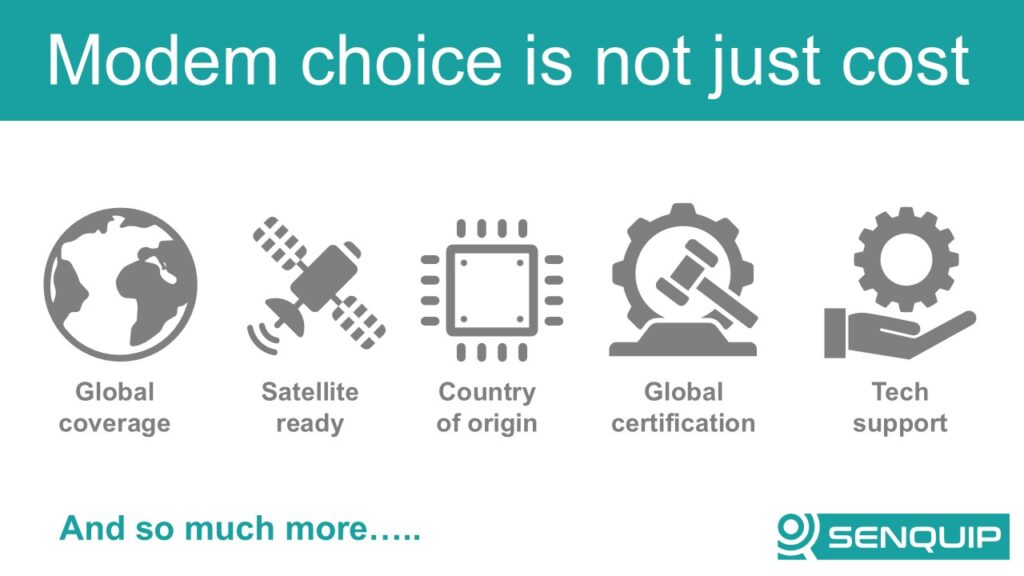
Choosing an industrial IoT modem is about far more than comparing purchase prices.
For products expected to remain in service for five to ten years, the modem becomes a strategic design decision. Network technologies evolve, supply chains change, certification requirements increase, and new connectivity options emerge.
When developing the latest generation of Senquip products, we evaluated every modem against a broad range of engineering criteria:
- Global cellular coverage
- Direct-to-Cell satellite readiness
- Silicon origin and technology provenance
- Global regulatory certification
- Technical support
- Long-term product availability
- Supply chain resilience
- Power consumption
- Cost
No single modem is perfect for every application, which is why our next-generation product range uses two carefully selected modem platforms.
ORB and QUAD
ORB and QUAD use a modem supporting:
- 2G
- 3G
- 4G Cat-1
- Direct-to-Cell satellite
These products are designed for customers deploying equipment globally, including regions where legacy cellular networks remain important. The result is a single hardware platform that can be deployed almost anywhere in the world.
UNI
UNI uses a 4G Cat-1 bis modem with Direct-to-Cell satellite capability.
For high-volume OEM applications, Cat-1 bis provides an excellent balance of:
- Cost
- Power consumption
- Performance
- Global deployment
while remaining ready for emerging satellite services.
Designing for the Future
One of the primary objectives for our next-generation products was to create a genuinely global platform.
Using a common hardware platform simplifies manufacturing, inventory management, certification, distributor support, and customer deployment. A single SKU can be installed in multiple markets without redesigning hardware for different regions.
Satellite connectivity was also a key design requirement. Every new Senquip product has been designed to support today’s cellular networks while being ready for tomorrow’s Direct-to-Cell satellite services.
Finally, supply chain confidence is becoming increasingly important as organisations place greater emphasis on cybersecurity, technology provenance, and long-term component availability. These considerations influenced our modem selection just as much as electrical performance or price.
There are always competing priorities.
In the end, an industrial IoT modem has one job:
Connect securely, reliably, and globally.